

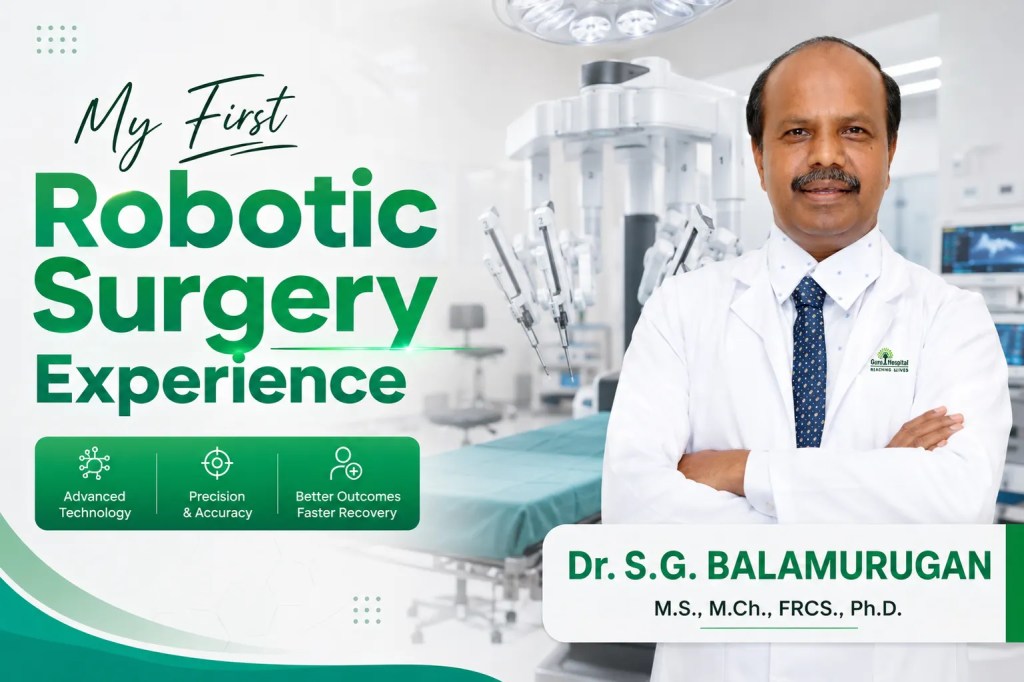
After more than 30 years of performing open and laparoscopic surgeries, I completed my first robotic-assisted surgery at Guru Hospital, Madurai. Using the MedBot TOUMAI MT-1000 SE Robotic Surgical System, we performed a left robotic radical nephrectomy for renal cell carcinoma. This marked an important new chapter in my surgical journey.
A New Beginning After 30 Years in Surgery
Surgery has always felt like a journey of experience to me. Learning may begin in medical school, but it never actually ends not after thirty years, not after five thousand cases. Over the past three decades, I’ve performed more than 5,000 open and laparoscopic surgeries. And yet, the first few moments I spent at the robotic console made me feel like a young trainee surgeon all over again. There’s something humbling about picking up new technology at this stage of a career, and adapting to it required setting aside old assumptions and starting, in some ways, fresh.
Introducing Robotic Surgery at Guru Hospital, Madurai
Guru Hospital recently introduced the TOUMAI robotic system as part of an ongoing effort to expand minimally invasive surgical services here in Madurai. Advanced surgical technology like this doesn’t replace clinical judgment, but it does extend what’s possible for selected procedures offering patients access to a level of precision that wasn’t available to us before. The system is currently being used for select surgical cases, with plans to expand as our team gains further experience with it.
My First Robotic Case
Left Robotic Radical Nephrectomy for Kidney Cancer
My first robotic case was a left robotic radical nephrectomy performed for a diagnosis of renal cell carcinoma. Radical nephrectomy — complete removal of the affected kidney — was chosen after a thorough evaluation of the tumour and the patient’s overall condition. Proper patient evaluation is essential before any surgical decision like this, robotic or otherwise. Out of respect for patient privacy, I won’t go into specific identifying details, but the case itself became a genuinely defining moment in my surgical career.
Dr. S.G. Balamurugan’s Experience at the Robotic Console
The moment I sat at the console, the feeling was difficult to put into words. Despite years of experience in laparoscopic surgery, this was an entirely different world. The control felt more direct, the visualization more immersive, and there was an emotional weight to learning a genuinely new technique after decades of doing things one way.
Three-Dimensional Vision and Magnified View
We naturally perceive the world in three dimensions, but the 3D vision through the robotic console is a different experience altogether. Every anatomical structure, every tissue plane, every fascial layer appeared vividly alive, with a depth and clarity I hadn’t quite experienced through a standard laparoscope. Small vessels, lymphatics, and fascial layers all became easier to identify with confidence.
Take the paracolic gutter, for example. In conventional laparoscopy, it often just reads as another tissue plane. Through the robotic console, it looked like a deep valley. That’s how significant the difference in depth perception really is.
Precision with Robotic Instruments
Wristed Instrument Movement
The robotic EndoWrist instruments allow movement that approaches what a human wrist can do — and in some ways goes beyond it. That flexibility made reaching difficult angles noticeably easier, and dissection, suturing, and clip application all felt more controlled as a result.
Tremor Filtration
Tremor filtration keeps instrument movement steady, which translates directly into finer tissue handling. Surgical actions feel more deliberate and controlled at every step.
Does the Robot Perform the Surgery?
No. The robot does not perform the operation independently. Every movement is controlled by the surgeon seated at the console. A robot has no brain it cannot make decisions and has no judgment of its own. Every dissection, every clip application, every use of energy comes entirely from the knowledge, skill, and experience of the surgeon operating it. The robot is simply a sophisticated tool that allows the surgeon to execute those skills with greater precision. Surgical experience remains just as essential as it always has been technology supports the surgeon, it doesn’t replace them.
Greater Control of the Camera and Instruments
In laparoscopic surgery, one assistant typically controls the camera while another handles tissue retraction — even adjusting the camera angle requires a second pair of hands. With robotic surgery, the surgeon independently controls the camera, the operating instruments, and even the third arm used for retraction, switching between them from the console itself. This reduces dependence on assistance considerably, though the bedside surgical team remains essential to the procedure running safely.
Viewing Anatomy from Different Angles
In laparoscopy, the camera is mostly used to zoom in and out. In robotic surgery, the camera can rotate to nearly any angle, letting the same anatomy be viewed from multiple perspectives until the surgeon finds the most comfortable and effective view.
“We are not changing the anatomy. We are changing the way we view it.”
That, to me, is one of the greatest strengths of this technology.

Robotic Surgery in Cancer Treatment
In surgical oncology, the objective is always complete tumour removal with no microscopic residual disease left behind. Magnified, layer-by-layer dissection, precise tissue handling, and clearer identification of tissue planes all support that goal along with lymph-node dissection when clinically indicated. Enhanced visualization and controlled dissection may help the surgeon follow established oncological principles more consistently. That said, surgical results ultimately depend on the cancer stage, the patient’s condition, the surgeon’s experience, and the overall treatment plan the technology supports good outcomes, it doesn’t guarantee them on its own.
Possible Benefits of Robotic-Assisted Surgery
Robotic-assisted surgery may offer smaller incisions compared with open surgery, a magnified surgical view, more precise instrument control, and a minimally invasive approach overall. For selected patients, this can translate into reduced postoperative discomfort and potentially faster recovery.
It’s worth being clear, though robotic surgery isn’t suitable for every patient. The right treatment approach can only be selected after a complete medical evaluation.
A Message to Young Surgeons
I want to share something honestly with younger surgeons reading this: I began robotic surgery later in my career, and I hope you don’t have to. Technology doesn’t wait for anyone, and the surgeons who learn it at the right time in their careers tend to benefit the most from it.
Build a strong foundation in open surgery first. Master laparoscopy. Understand surgical anatomy thoroughly, and hold onto sound oncological principles throughout. Then, embrace robotic surgery at the appropriate stage in your training. Doing so will elevate your entire surgical journey and honestly, learning never really stops, at any stage of the career.
What My First Robotic Surgery Taught Me
Technology continues to change. Surgical platforms continue to improve. Instruments keep getting refined. But some things don’t change at all respect for anatomy, gentle tissue handling, meticulous dissection, patient safety, and sound clinical judgment. These remain the true hallmarks of a good surgeon, regardless of what tool is in hand.
A surgeon never stops learning. The day we stop learning is the day we stop growing.
A New Chapter at Guru Hospital, Madurai
This was not just another operation. It was the day that thirty years of surgical experience met a new technology — a genuine milestone, and one I’ll remember clearly. It reflects a broader commitment at Guru Hospital toward advanced, patient-centred surgical care, and it marks the beginning of what I hope is an ongoing effort to offer our patients safer, more precise, world-class surgical options going forward. To know whether robotic-assisted surgery is suitable for your condition, consult the surgical team at Guru Hospital, Madurai, for a detailed evaluation and personalised treatment plan.
Common Questions About Robotic Radical Nephrectomy
What is robotic radical nephrectomy?
It is a robot-assisted procedure used to remove a kidney affected by cancer when complete kidney removal is medically required.
Can robotic surgery be used for kidney cancer?
Yes. Robotic surgery may be used for selected kidney cancer cases based on tumour size, location, stage, and the patient’s overall health.
How is robotic surgery different from laparoscopic surgery?
Robotic surgery provides a three-dimensional, magnified view along with wristed instruments that allow greater movement and control than conventional laparoscopy.
Is robotic surgery suitable for every patient?
No. Suitability depends on the patient’s condition, diagnosis, prior surgeries, and the surgeon’s clinical assessment.
